Voices in Dialogue-FemPawer Closing
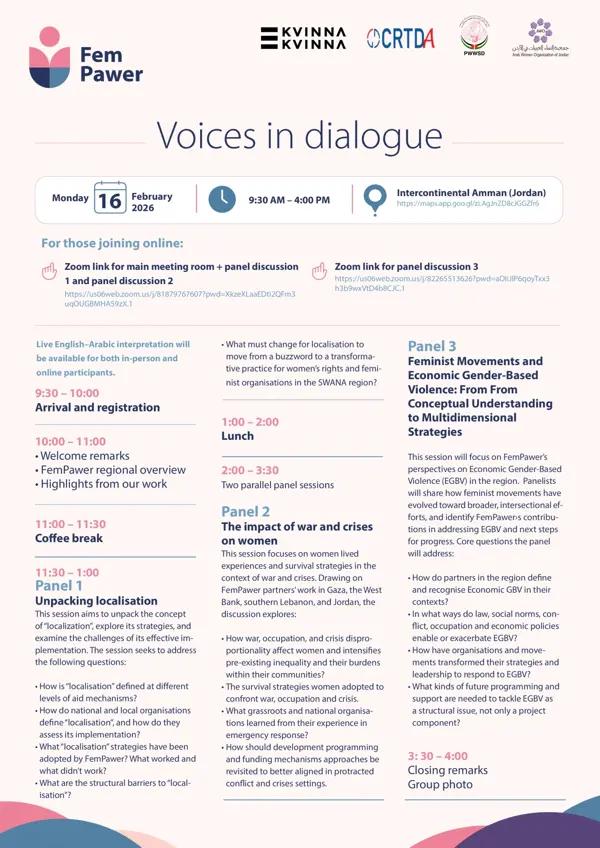
Voices in Dialogue
9:30 AM – 4:00 PM
Intercontinental Amman (Jordan)
Live English–Arabic interpretation will be available for both in-person and online participants.
11:30 – 1:00
Panel 1
Unpacking localisation
This session aims to unpack the concept of “localization”, explore its strategies, and examine the challenges of its effective implementation. The session seeks to address the following questions:
How is “localisation” defined at different levels of aid mechanisms?
How do national and local organisations define “localisation”, and how do they assess its implementation?
What “localisation” strategies have been adopted by FemPawer? What worked and what didn’t work?
What are the structural barriers to “localisation”?
What must change for localisation to move from a buzzword to a transformative practice for women’s rights and feminist organisations in the SWANA region?
Panel 2
The impact of war and crises on women
This session focuses on women’s lived experiences and survival strategies in the context of war and crises. Drawing on FemPawer partners’ work in Gaza, the West Bank, southern Lebanon, and Jordan, the discussion explores:
How war, occupation, and crisis disproportionately affect women and intensify pre-existing inequality and their burdens within their communities?
The survival strategies women adopted to confront war, occupation and crisis.
What grassroots and national organisations learned from their experience in emergency response?
How should development programming and funding mechanisms approaches be revisited to better align in protracted conflict and crises settings?
Panel 3
Feminist Movements and Economic Gender-Based Violence:
From Conceptual Understanding to Multidimensional Strategies
This session will focus on FemPawer’s perspectives on Economic Gender-Based Violence (EGBV) in the region. Panelists will share how feminist movements have evolved toward broader, intersectional efforts, and identify FemPawer’s contributions in addressing EGBV and next steps for progress.
Core questions the panel will address:
How do partners in the region define and recognise Economic GBV in their contexts?
In what ways do law, social norms, conflict, occupation and economic policies enable or exacerbate EGBV?
How have organisations and movements transformed their strategies and leadership to respond to EGBV?
What kinds of future programming and support are needed to tackle EGBV as a structural issue, not only a project component?